
Finding Recent Jefferson Parish Arrests
Start with the JPSO Online Inmate Search for any Jefferson Parish booking. It lists people accepted into the Jefferson Parish Correctional Center. City police sometimes transfer arrestees there too. You get a structured search form. It is not a dated photo gallery or daily arrest feed. Each entry reflects a booking into the jail rather than a narrative of the case.
| Time window | Best route | What it can answer | Important limit |
|---|---|---|---|
| Same day | Arrests Last 24 Hours | How to check a booking believed to have happened today or overnight | JPSO does not publish a verified rolling 24-hour feed |
| Several days | Police Blotter | How to reconstruct a multi-day booking picture from official and dated sources | News and republication pages are selective or unofficial |
| Current custody | JPSO inmate inquiry | Booking identity, charges, and bond lines | Release or transfer can change the result |
| Ongoing status | VINELink Custody Check | Search and notification after an arrest | VINE is not the court disposition |
JPSO publishes no daily booking archive. So the practical skill is knowing which system answers which question. Timing matters as well. Someone can be under arrest while fingerprinting, classification, and data entry are still in progress. Recheck the roster later, or call Corrections directly when a custody question is urgent.
"Booked" and "in custody" are related but not equal. Booking is the jail's intake step, when staff create the record and its identification fields. In custody describes the person's current status at the moment the system refreshes. A release or transfer can change that status field. Intake still happened, and the record keeps that fact. So note the CCN and arrest date whenever a match appears. A name alone is weak. The display can change. Two people can share similar identifiers.
People also move between systems at different stages of a case. Parish booking comes first for most local arrests. LA VINE then handles custody monitoring, and the court docket carries the legal case. A later state sentence points you to DPS&C. A federal hold requires a different locator. Keep each source's number handy. The most common reason a valid record seems to vanish is a numbering mismatch. Someone searches one system with another agency's number.
When Does a New Booking Appear?
JPSO promises no fixed posting interval. A person arrested overnight may show up only after the jail finishes intake. The booking date may not match the arrest time either. The sensible sequence is to search the official roster by name. Then narrow with the custody and date filters, and try again later if intake may still be running. The same-day arrest guide walks through confirming an overnight booking. An empty search never proves that no arrest occurred.
For a known person, the VINELink custody check adds statewide status plus optional alerts. It works best after you find a record. It does not replace JPSO's booking fields or the court docket.
When a roster search comes up empty, test your assumptions in order. Confirm the spelling. Consider whether the person might use another name. Widen the booking-date range and drop the current-custody filter. Verify that the arresting agency actually booked the person into Jefferson Parish Jail. For a current-status question, the corrections line is the right call. A past booking calls for a focused public-record request. An active case belongs with the clerk. Each step answers a different question. Following the custody state beats repeating the same name search across unofficial sites.
Search the Jefferson Parish Jail Roster
The official portal takes name, race, sex, arrest date, CCN, and date of birth. A CCN with a birth date beats a name search. Similar names get confused easily. Each result shows name, CCN, race, and sex. It also lists date of birth, arrest date, charge lines, and bond. No photo column appears. The portal also publishes no refresh schedule or archive depth. Treat it as a current-status tool rather than a historical index.
| Search field | Use | Caution |
|---|---|---|
| Name | Starting without an identifier | Match birth and arrest dates |
| CCN | Narrowing the JPSO identity | Do not confuse it with a court or DOC number |
| Arrest date | Building a bounded time window | It is not a conviction date |
| Date of birth | Separating similar names | Verify against another field |
| Race and sex | Secondary filtering | Never enough to prove identity alone |
- Open the official JPSO search and enter the narrowest known facts.
- Match name, CCN, birth date, and arrest date before selecting a person.
- Read each charge and bond line as booking data, not a court result.
- Note the page's last-updated time and call the relevant city jail if the entry is absent.
The official Louisiana DOC parish page documents the local custody handoff and agency contacts.
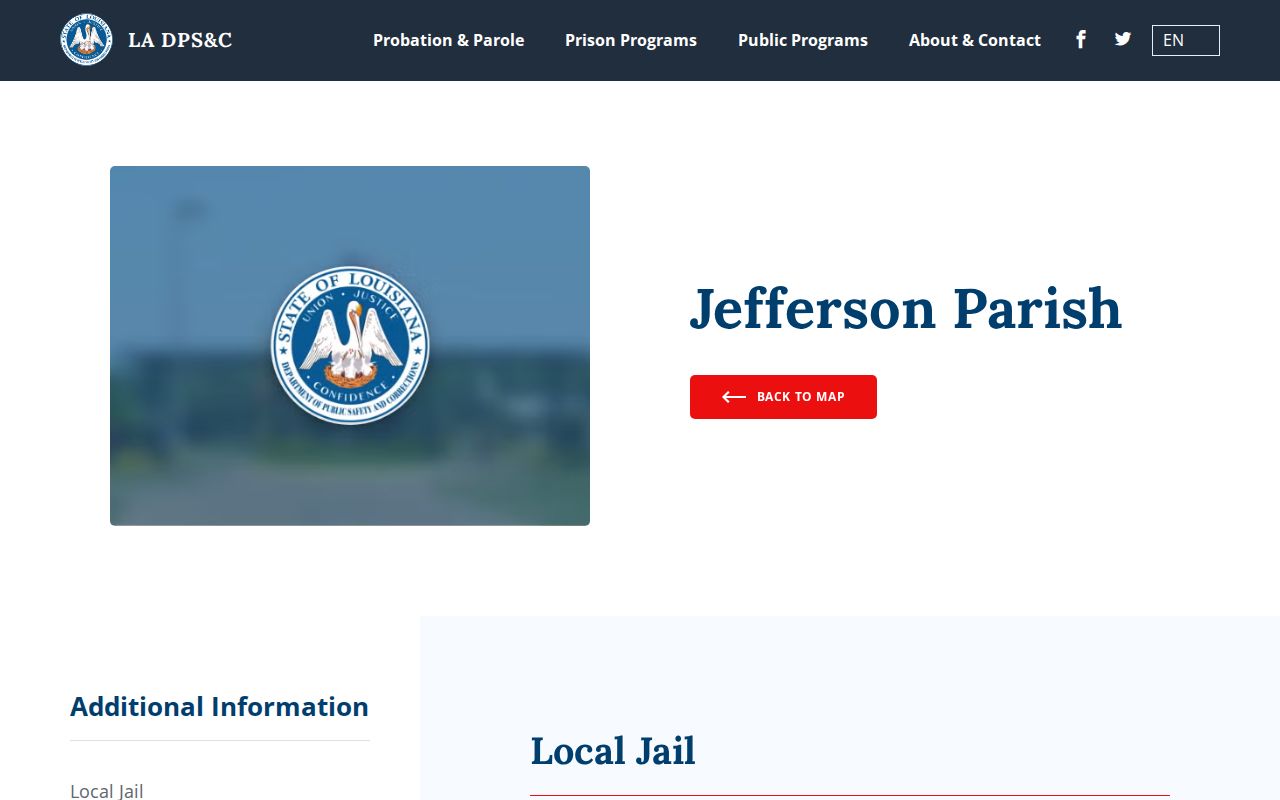
The JPSO website points you toward the right tool rather than listing people itself. The sheriff's office publishes no mobile booking feed, so the parish inmate search stays the place to start.
Jefferson Tips Are Not Booking Feeds
JPSO news pages and social posts do one job, and booking data does another. Neither channel serves as a same-day Jefferson Parish arrest feed. A flashy Facebook post can show up days before or after a name hits the roster. The timing is a communication choice. It is not a booking schedule. Silence means even less. A quiet news page never proves the parish jail took in nobody that day. For custody facts, the Jefferson Parish inmate roster remains the official record. VINE tracks whether a person is still held. The court file is where a charge finally gets its legal outcome. Treat news as context and the roster as the arrest data.
Where Jefferson Booking Information Appears
Start every Jefferson Parish arrest lookup with the official record. Private sites can point you toward a date or a news item. But they lag behind releases, and they keep old booking photos. They double-list a single arrest, too. Sometimes they credit the wrong agency. Treat them as leads only. Confirm each detail against JPSO or the court before you rely on it.
| Channel | Photos? | Status | How to use it |
|---|---|---|---|
| JPSO search | No photo column observed | Official | Booking identity, charges, and bond |
| JPSO FID/Public Records | Separate request | Official | Request a photo or fuller record |
| Louisiana VINE | No | Official | Custody status and alerts |
| JeffNet | Document images vary | Official clerk system | Case activity and disposition |
| NOLA.com, FOX 8, WDSU, WWL | Sometimes | Independent news | Selected dated stories only |
| Private booking directories | May copy images | Unofficial | Verify every claim officially |
The FOX 8 crime index illustrates the article-based channel.
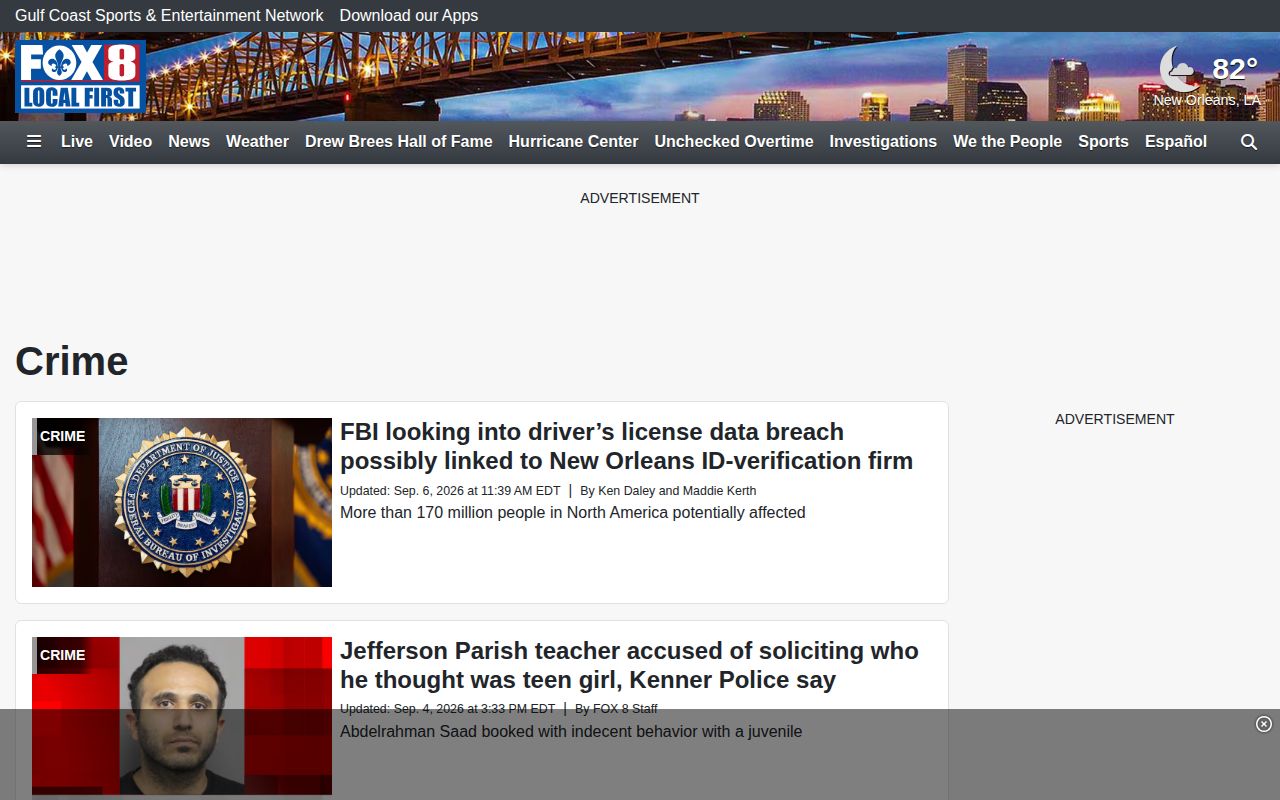
News stories add context to selected Jefferson Parish arrests. They are not a full arrest list, though, and never the government record itself. Several unofficial indexes sit alongside them. Mugshots.com's Jefferson Parish index is one, and JailExchange's JPCC directory is another secondary reference. Both are starting points, nothing more. Check every name, date, and status with JPSO or the court. Arrests.org, RecentlyBooked, Busted Newspaper, and Mugshots.zone carry no current Jefferson Parish page. Jefferson Davis Parish or Jefferson County results point elsewhere. Those are the wrong jurisdictions. One more caution: a private archive's depth says nothing about what the sheriff actually retains.
Recent Arrests by City
City police records and parish jail records answer two different questions. The police department keeps its own incident or arrest report. JPSO holds the booking record. That starts once the person enters Jefferson Parish Jail. Match them through the arresting-agency field.
- Kenner Recent Arrests: Kenner has a 64-person misdemeanor jail, so check its jail phone and JPSO.
- Gretna Recent Arrests: Gretna Police holds city reports, while nearby JPCC may receive transfers.
- Harahan Recent Arrests: Harahan has a documented booking function but no public city roster was found.
A city arrest sometimes becomes a filed court case. The right court source then moves your search past the booking entry toward the official result.
Reading a Jefferson Parish Arrest Record
A jail entry gathers name, arrest date, charge, and bond in one place. It is not the final case file. A roster view and a court record answer separate questions, so use both when the outcome matters.
- Name and date of birth
- Identity clues that should be matched with the arrest date.
- Inmate CCN
- The identifier shown in JPSO results.
- Race and sex
- Secondary match fields that do not establish identity alone.
- Arrest date
- The reported date of arrest, not a conviction date.
- Charge lines
- Charges entered with the booking, not findings of guilt.
- Bond lines
- Displayed bond information, not proof of payment or release.
The JPSO result bundles identity, arrest date, charge, and bond data. Read it as a booking record. A few terms deserve care. An arraignment is the hearing where the court formally addresses the charge. A plea may be entered there. A disposition is the court's recorded result. A detainer is a request or authority from another agency that can affect release. The other agency wants custody. An expungement removes qualifying material from public access under Louisiana procedure. Authorized justice agencies may still reach it, though. Photographs reveal none of this. Trust the labeled field and the office that owns it.
Released from Jefferson Parish Custody
A listed bond speaks to release conditions only. It shows no payment and no case result. A release also pulls a person off the roster's current-custody view, yet the booking and the court case still stand. That is a custody change, not a vanished charge. Search by booking number and date. Then follow the docket through the Clerk or the correct court.
Jefferson Parish Mugshots After Arrest
The JPSO roster shows no booking photographs. The office runs a separate photo-copy route through FID or the Public Records Center, at $10 per photo. Requests need your contact details plus the arrestee's full name, date of birth, and arrest date, with payment and delivery choices. JPSO says same-business-day processing. A booking photo simply identifies someone arrested or in custody. Juvenile status, protected material, an active investigation, an identity mismatch, or technical absence can all block access. Private copies are unofficial and may be stale. No booking-photo gallery is hosted here.
Some Jefferson Arrest Records Stay Closed
Public-record status does not force the release of every arrest page, image, or report. JPSO policy lists several categories that may be privileged or withheld. These include juvenile records and sexual-offense victim information. Confidential sources, undercover officers, and investigative or security material complete the list. Louisiana R.S. 14:133.7 protects confidential juvenile data on its own. It also limits publication after an expungement or nondisclosure notice. A narrow request helps the custodian sort releasable material from protected content. If JPSO denies part of a request, ask which exemption applies. A redacted version may exist, so request that too. A lawful withholding implies no guilt and no concealment.
Request a Jefferson Arrest Record
JPSO takes record requests through its online Public Records Center. Walk-ins go to Central Records, Building A, 1233 Westbank Expressway, Harvey, Louisiana 70058. The office lists 504-363-5590. Weekday hours are 8:00 a.m. to 4:00 p.m.
- Preserve the exact name, date of birth, arrest date, and CCN.
- Ask for an existing booking entry, Article 228 summary, Arrest Register, charge or bond lines, or booking photograph.
- Submit online or in person and state the preferred format.
- Check the current fee schedule. JPSO publishes $25 for an Arrest Register and $10 for a mugshot copy.
- For withheld material, ask for the exemption, redaction basis, or retention schedule.
Jefferson Parish sets no fixed turnaround for record requests. Sealed and expunged files sit in a different category entirely. Article 971 pulls an expunged arrest record out of public view while keeping it open to authorized criminal-justice access. A website may republish a dismissed, sealed, corrected, expunged, or wrong-person entry. The fix starts with that publisher's own free correction channel. Send the record URL and any supporting documentation. Don't pay a middleman to ask for you. And even after a publisher removes an entry, cached search results can linger, so patience beats expecting an instant wipe.
A booking sheet and an incident report are two different records, too. The jail builds the booking sheet at intake. The investigating or arresting agency keeps the fuller narrative. When Kenner, Gretna, or Harahan police made the arrest, name that agency in the request instead of assuming JPSO owns the whole story. JPSO can still hold the jail record, because the person was booked into the parish facility. Tight wording cuts delay.
Keep your copy of everything. Save the request, the mailing date, and any invoice. If the photograph is the only item you need, say so plainly. JPSO posts a separate per-page photograph charge. Ask for electronic delivery as a preference only, since policy controls the format. Precise wording also tells a missing record apart from an exempt one.
Which Jefferson Parish Court Applies?
Jefferson's court records are scattered. No single database holds them all. The 24th Judicial District Court, the First and Second Parish Courts, and municipal or local forums each control cases within their own jurisdiction. A booking page may list a court. That field can also sit blank or carry a preliminary docket number. The Clerk cautions that its online index is unofficial, and a new case may not be indexed yet. So don't conclude an arrest has no case. If a search comes up empty, take the court and docket from the booking, then call the responsible clerk. That beats trusting an empty web index.
Jefferson Arrest Records Cross Locations
Jefferson Parish records live in more than one office. JPCC sits in Gretna. Central Records sits in Harvey. City police departments keep their own reports and short-term custody records. One Jefferson Parish arrest can touch four places: a municipal agency, the parish jail, JPSO records, and a separate court index. So follow the record by function. Ask the arresting department for its incident report, JPSO for the booking sheet or photograph, Corrections for current jail status, and the right clerk for disposition.
Louisiana Arrest Records, Photos, and Retention
Louisiana R.S. 44:1 reads broadly. It covers photographs and electronic data too, though statutory exceptions still apply. C.Cr.P. article 228 requires prompt booking and lists the minimum booking-summary details. Juvenile, expunged, and investigative material can be withheld under whichever law governs that record.
The captured Louisiana Legislature R.S. 44:1 page shows the public-record and custodian framework.
Read the statute itself. Older summaries of Louisiana mugshot law can mislead. On retention, R.S. 44:36 sets a three-year minimum when no other period applies, unless an approved schedule governs.
That three years is a floor, not a promise. A Jefferson Parish booking will not stay on the roster the whole time. JPSO, the Jefferson Clerk, DPS&C, and the State Archives each hold different record series under different schedules. For older material, ask JPSO about the applicable schedule and transfer history. Give a date range and a record series.
The Louisiana State Archives describes a tidy system. Agencies inventory physical and electronic records, submit schedules for approval, and request disposal once the period passes. Photos, sound recordings, and computer files count too. The Archives lists no public catalog entry for a routine, current Jefferson Parish booking-photo collection. So don't assume an old jail image rests there. Ask the sheriff about booking sheets and images, the Clerk about court series, and Archives staff about any named series that was transferred.
Portal visibility and legal retention are separate things. A page can vanish after release while the agency record lives on. A page can also vanish from a redesign, a correction, or an outage. Only the custodian knows which. Name the agency, series, date range, and medium. Booking photographs and jail-management exports are examples. That detail lets JPSO or Archives staff pinpoint a schedule, a disposal authorization, or a transfer history.
Jefferson Parish Warrants and Wanted Notices
Jefferson Parish warrants start with the JPSO Warrants Division. The office handles warrant service, though it publishes no full self-service warrant database for the public. What you can browse is JPSO Crimestoppers. That wanted list is selective, showing a photo, charge, agency, and physical descriptors for a handful of fugitives. It is not every active Jefferson Parish warrant.
Worried about a warrant in your own name? Call the Warrants Division at 504-363-5500 or ask a lawyer for current official confirmation. The Gretna Business Office also lists warrant service among its duties. Never confront someone shown on a wanted notice. Anonymous tips go to Crimestoppers at 504-822-1111. Those channels take tips, not custody searches.
A warrant authorizes an arrest, nothing more. Status can change quickly. So skip the undated social post and the copied third-party page, and get word from the office itself. Hand details to the listed authority. Then step back and let them work.
After an Arrest: Follow the Court Case
A Jefferson Parish arrest record is only the first page of the story. The jail shows who was booked and when. The courts show what happened next. Two clerks split that work here. The 24th Judicial District Court handles felony cases, while First and Second Parish Courts cover the rest of Jefferson Parish's criminal jurisdiction. Match the name, arrest date, and identifiers first. Then check JeffNet and the responsible clerk.
The case usually moves in stages. Arrest, booking, photograph, then an initial court appearance. Bond decisions and filing decisions come after that, handled by different offices moving at different speeds. A booking charge can shift once a prosecutor files. The court may later record a plea, dismissal, diversion, or a sentence. So the final court record outweighs any stale booking label.
Bond can appear early in the sequence. That line concerns release conditions, not the merits of the case. If a released person drops from a current view, request the jail record using the CCN and arrest date. Then follow the court case separately.
Why can the jail and court pages disagree? They track different stages. Updates land on different schedules too. Match the docket and booking identifiers, then treat the court's official record as the word on the legal outcome.
From Parish Jail to Other Custody Systems
Custody changes tell you where to search. The JPSO CCN only works inside the parish system. After a state sentence or transfer, try the Louisiana Department of Public Safety & Corrections inmate-information page or call its phone locator at 225-383-4580. DPS&C gives state location and release details and points to VINE. But it will not cover every recent Jefferson Parish arrest. Read the booking-photo explanation before judging any image.
Federal custody runs on its own identifiers. The Federal Bureau of Prisons locator holds federal inmates from 1982 forward. It offers no public booking-photo field. The ICE Online Detainee Locator searches current ICE custody, or CBP custody past 48 hours. You need an exact A-number or exact biographical details. An empty result in one system does not mean freedom. The person may simply sit in another custody layer.
Keep each identifier separate. The JPSO CCN, court case number, VINE record, DPS&C number, BOP register number, and ICE A-number never interchange.
Cannot find the person? A fresh local arrest belongs to JPSO. Release or transfer alerts belong to VINE. A sentenced Louisiana prisoner belongs to DPS&C. Federal imprisonment goes to BOP, and qualifying immigration custody to ICE. Write down each date and result. That custody timeline beats treating every locator as one shared, evenly updated pool.